
Swipe right
Case Study: A Gear Manufacturing Plant in Jiangsu | The JXLC40A Dual-Station CNC Vertical Lathe from Juxin Supports the Upgrade of an Automated Production Line
01 Project Background: Capacity Upgrade, with Space Becoming a New Challenge
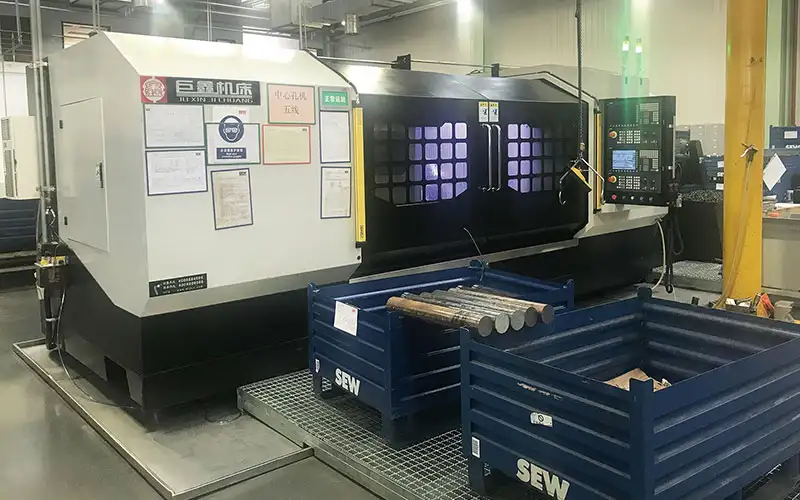
As production demands and capacity planning evolved, a gear manufacturing plant in Jiangsu Province purchased a JXLC40A dual‑station CNC vertical lathe from Juxin Machine Tool in 2022 for gear machining.
At the time, the customer’s primary needs encompassed not only increasing equipment capacity but also implementing automation upgrades and optimizing production‑floor layout.
Traditional production line layouts require comprehensive consideration of machine tool footprint, loading and unloading positions, inter‑equipment transfer distances, and the operating space for robotic arms. As the number of equipment increases and the level of automation rises, the layout of the production line directly impacts both space utilization and the cost of building the line.
For gear manufacturers that require continuous batch processing, how to achieve capacity upgrades within a constrained facility space is a critical consideration that must be addressed in both equipment selection and production-line planning.
02 New Factory Layout: Dual-Station CNC Vertical Lathes Become the Standard Configuration
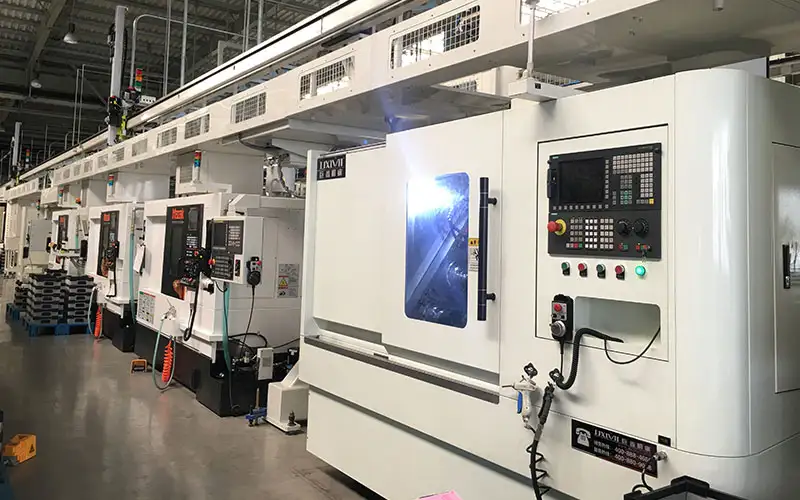
In the construction of its new plant and the layout of its production facilities, the customer opted to deploy exclusively Juxin’s dual‑station CNC vertical lathes.
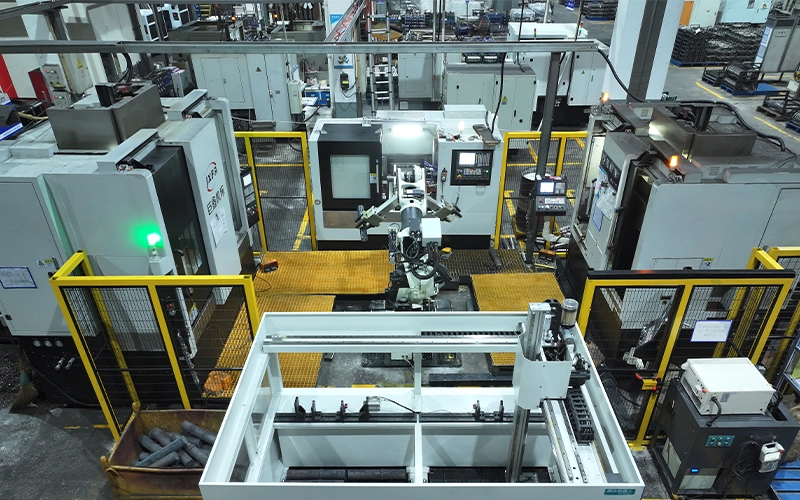
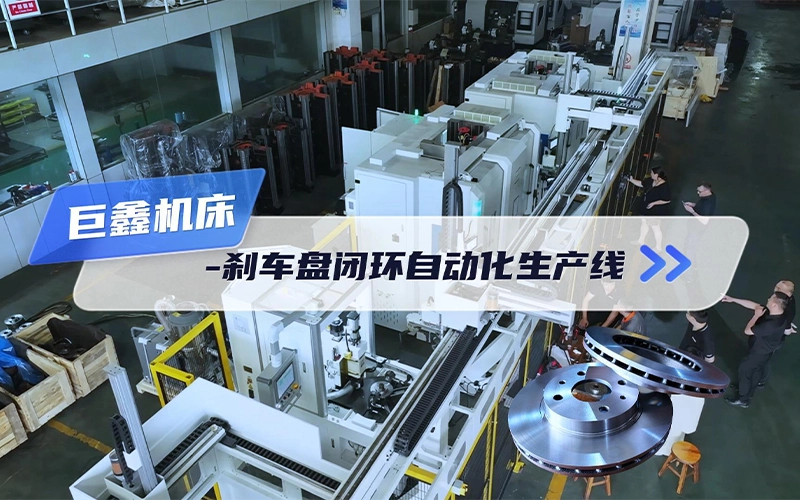
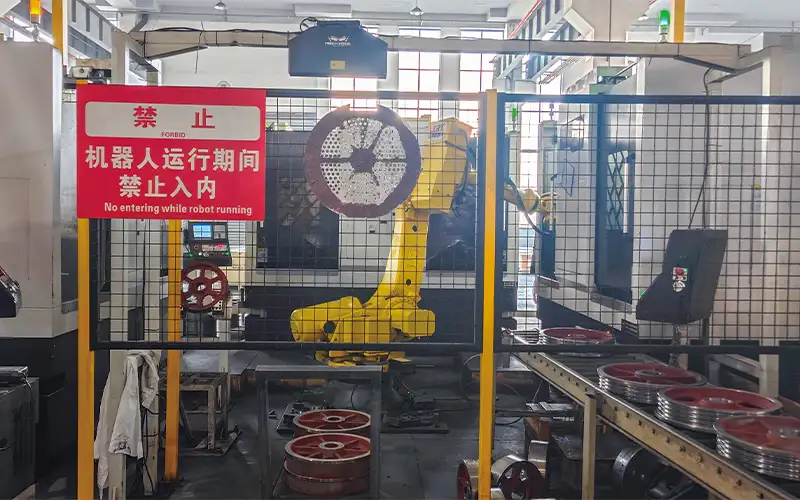
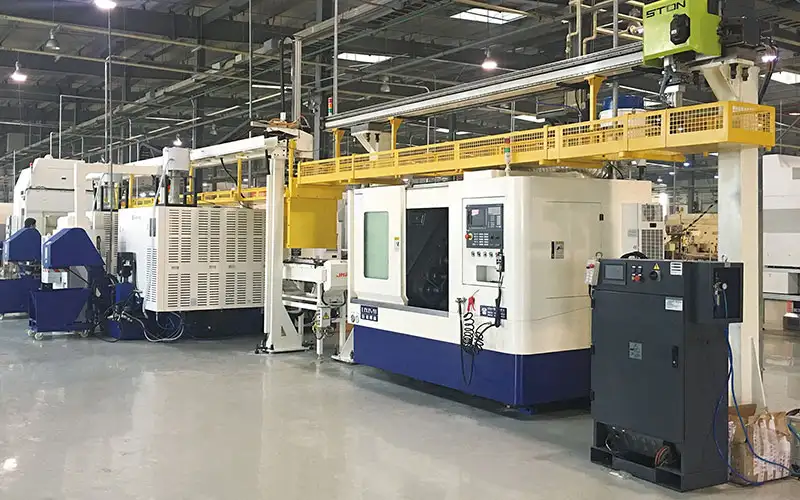
The production line is configured with a single dual‑station CNC vertical lathe paired with a robotic arm, with the equipment arranged face‑to‑face.
In this configuration, the machine tool and the robotic arm are jointly designed to enable automated loading and unloading. Workers are primarily responsible for loading and unloading the material storage bin, while the remaining machining processes are seamlessly integrated through automated systems, thereby minimizing direct human involvement in the machine’s loading and unloading operations.
The key to this solution lies not merely in the use of a robotic arm, but in integrating machine tool layout, equipment placement, robotic‑arm operation, and human‑operator workstations into a unified planning framework.
03 Production Line Layout Optimization: It’s Not Just About the Equipment—It’s About the Entire Production Line
First, shorten the layout distance of the automated production line.
By coordinating a dual‑station CNC vertical lathe with a robotic arm and adopting a face-to-face arrangement, the customer optimized the overall layout of the automated production line, thereby reducing the line’s footprint.
Second, reduce the cost of setting up automated production lines.
Production line planning encompasses not only machine tool procurement but also robotic arm configuration, equipment spacing, material handling, and facility layout. Properly positioning machine tools and robotic arms helps minimize unnecessary space requirements and transport distances, thereby reducing overall line‑setup costs.
According to customer feedback, this solution has reduced the cost of setting up automated production lines. The specific savings in amount and percentage will be determined based on actual project data.
Third, enhance the efficiency of utilizing limited space.
For manufacturing enterprises with limited floor space that also seek to increase production capacity, equipment selection should not focus solely on the performance of individual machine tools; it must also take into account the footprint required when multiple machines are combined and the resulting line‑layout configuration.
The customer has standardized on Juxin’s dual‑station CNC vertical lathes across its new facility and integrated robotic systems in a face‑to‑face configuration, reflecting a shift from standalone equipment procurement to holistic production‑line planning.
04 Staffing: 1 person manages 2 production lines
After the automated production lines were commissioned, the customer adopted a staffing model in which one operator manages two production lines.
Workers are primarily responsible for loading and unloading materials at the material bin, while machine-tool machining and robotic handling are coordinated to minimize the need for personnel to repeatedly perform loading and unloading operations across multiple machines.
According to customer feedback, this solution has reduced labor requirements by half compared with the previous production organization.
It should be noted that the actual staffing levels are influenced by factors such as workpiece type, processing cycle time, material‑storage capacity, equipment operating status, and on‑site management practices; therefore, each project must be planned in alignment with its specific production conditions.
05 Case Value: From Single-Unit Equipment Selection to Automated Production Line Planning
An application at a gear manufacturing plant in Jiangsu demonstrates that capacity upgrades do not necessarily involve simply increasing the number of machine tools.
When companies simultaneously face constraints such as limited floor space, the need for automation upgrades, and the optimization of manual resource allocation, they must also take a holistic approach, considering the entire production line—including machine tool architecture, robotic arm configuration, equipment layout, and material handling methods.
In 2022, the customer purchased Juxin’s JXLC40A dual‑station CNC vertical lathe and standardized its use across the new facility, pairing it with a robotic arm and a face‑to‑face layout. According to customer feedback, this solution shortened the distance between stations on the automated production line, reduced installation costs, and enabled a single operator to manage two lines while cutting labor requirements by half.
For companies planning to implement batch gear machining and automation upgrades, simultaneous planning of equipment selection and production-line layout helps to more comprehensively assess space requirements, staffing needs, and investment needs.
Case Description: The production layout and application results described in this paper are based on information provided by the customer. The actual line configuration and operational performance must be evaluated in conjunction with the workpiece, processing cycle time, automation setup, and site-specific conditions.






Contact Us
WhatsApp:
Contact E-mail:
Contact Address: